
Introduction
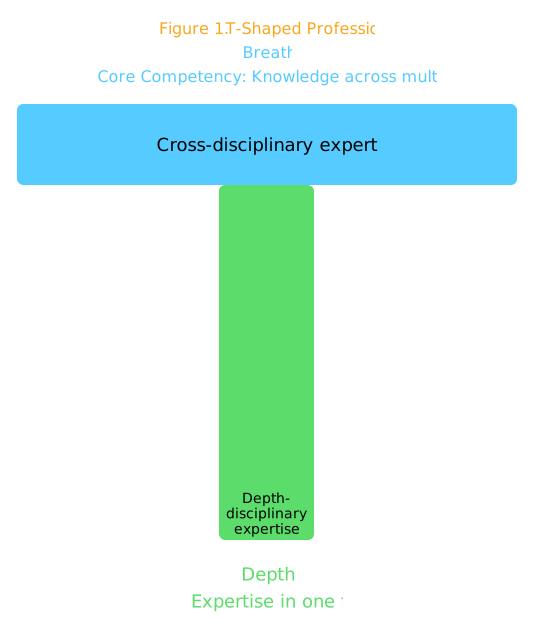
- The Vertical Bar (Depth): This is your superpower. It’s that one specific area where you are the undeniable expert. Maybe it’s the billing system, the intricacies of the rendering pipeline or infrastructure. When the team is stuck on this, they look at you.
- The Horizontal Bar (Breadth): This is your context. You don’t need to be an expert in everything, but you have working knowledge across the stack. You understand how the database, design system, and CI/CD pipeline connect to your work.
So the point is not to be like:
“Jack of all trades, Master of none”
How to measure T-shaped learning?
The most effective approach is to measure its three observable components separately: depth, breadth, and the ability to integrate knowledge across domains. The T-shaped model traditionally represents depth in one field and breadth across related fields.
Suggested formula
where:
- = depth of expertise in the primary discipline.
- = breadth of useful knowledge across related disciplines.
- = integration or transfer of knowledge across disciplines.
- = weights, with
A practical default is:
The geometric form is preferable to a simple weighted sum because a very high depth score cannot completely hide extremely poor breadth or integration.
Component formulas
First choose a scoring scale
Use this rubric for each skill or assessment item:
╭───────┬──────────────────────────────────────────────────────────────────╮
│ Score │ Interpretation                                                   │
├───────┼──────────────────────────────────────────────────────────────────┤
│ 0     │ No knowledge or experience                                       │
│ 1     │ Understands basic terms; needs complete guidance                 │
│ 2     │ Can perform simple tasks with supervision                        │
│ 3     │ Can work independently on normal tasks                           │
│ 4     │ Handles complex work and helps others                            │
│ 5     │ Sets standards, mentors others, or is recognized as an authority │
╰───────┴──────────────────────────────────────────────────────────────────╯
This type of anchored scale is more reliable than asking someone to assign a vague percentage to their own ability. Technical tests and work samples are especially useful for depth, while scenario-based and cross-functional assessments are useful for breadth.
Let:
1. Depth score
Depth measures mastery in one chosen core discipline. For example, a software engineer might choose Python and backend engineering as the primary discipline.
Depth is evaluated using several indicators like:
- conceptual understanding,
- independent execution,
- quality of practical work,
- problem-solving ability,
- teaching or mentoring,
- peer or expert validation.
Then:
Where:
- is the normalized score for depth indicator ,
- is its importance weight,
- .
2. Breath score
Breadth measures useful working knowledge in adjacent disciplines. It does not mean collecting a long list of technologies; it means being able to understand and contribute across related areas.
For adjacent disciplines:
Where measures useful competence in discipline , not merely exposure to it.
A useful proficiency scale is:
╭───────┬────────────────────────────────────────────╮
│ Score │ Meaning                                    │
├───────┼────────────────────────────────────────────┤
│ 0     │ No meaningful knowledge                    │
│ 0.25  │ Awareness of basic terms                   │
│ 0.50  │ Can understand and discuss the domain      │
│ 0.75  │ Can apply it in collaboration              │
│ 1.00  │ Can independently use it for relevant work │
╰───────┴────────────────────────────────────────────╯
This prevents breadth from being inflated by listing many topics that have only been encountered superficially.
3. Integration score
To measure whether the learner can combine knowledge from multiple areas:
Integration is important because a person may have both broad and deep knowledge but still be unable to connect them in practice.
Recommended assessment method
Do not calculate the score only from study hours or self-reported confidence. Assess depth and breadth separately using evidence such as technical tests, work samples, portfolios, structured interviews, cross-functional case studies, and peer review.
For a software engineer, an example profile could be:
- Depth: Python, distributed systems, or reliability engineering.
- Breadth: databases, networking, security, UX, product thinking, and technical writing.
- Integration: designing and operating a production system that combines software architecture, observability, security, cost, and user requirements.
For periodic tracking, calculate the score every three or six months:
Sample assessment by example
A practical way to calculate T-shaped learning is to score depth, breadth, and integration separately on a common scale, normalize them to and then combine them. The three dimensions should remain separate because deep expertise, broad knowledge, and cross-disciplinary application are different abilities.
1. Let scoring scale be
2. Calculate the depth score
Depth measures mastery in one chosen core discipline. For example, a software engineer might choose Python and backend engineering as the primary discipline.
Assess depth using several indicators:
╭──────────────────────────────────┬────────┬───────╮
│ Depth indicator                  │ Weight │ Score │
├──────────────────────────────────┼────────┼───────┤
│ Fundamental concepts             │ 0.25   │ 4     │
│ Practical implementation         │ 0.30   │ 5     │
│ Complex problem solving          │ 0.25   │ 4     │
│ Quality, testing, and reliability│ 0.20   │ 3     │
╰──────────────────────────────────┴────────┴───────╯
The weights must add up to :
Calculate the weighted raw depth score:
Normalize it:
Therefore:
3. Calculate the breadth score
Breadth measures useful working knowledge in adjacent disciplines. It does not mean collecting a long list of technologies; it means being able to understand and contribute across related areas.
For the same software engineer, select four adjacent domains:
╭─────────────────────────┬──────────┬───────╮
│ Adjacent domain         │ Weight   │ Score │
├─────────────────────────┼──────────┼───────┤
│ Databases               │ 0.25     │ 3     │
│ Networking              │ 0.25     │ 3     │
│ Security                │ 0.25     │ 2     │
│ UX and product thinking │ 0.25     │ 4     │
╰─────────────────────────┴──────────┴───────╯Normalize it:
Therefore:
4. Calculate the integration score
Integration measures whether the learner can connect and apply multiple disciplines to solve a real problem. It is the part that makes the profile genuinely T-shaped rather than merely “deep plus a list of interests.” T-shaped capability includes applying knowledge beyond one’s own specialty and collaborating across boundaries.
Assess integration using practical evidence:
╭─────────────────────────────────────────────┬───────┬───────╮
│ Integration Indicator                       │ Weight│ Score │
├─────────────────────────────────────────────┼───────┼───────┤
│ Combines multiple domains in one project    │ 0.30  │ 4     │
│ Explains trade‑offs to other specialists    │ 0.20  │ 3     │
│ Transfers a technique between domains       │ 0.25  │ 4     │
│ Produces measurable cross‑functional results│ 0.25  │ 3     │
╰─────────────────────────────────────────────┴───────┴───────╯Normalize it:
Therefore:
A strong integration example for this engineer might be:
Designed a Python service, selected a database schema, introduced network timeouts, added security controls, and created monitoring dashboards while explaining the trade-offs to product and operations teams.
That demonstrates depth in software development, breadth in databases, networking, security, and operations, and integration across all of them.
5. Calculate the final T score
Use the geometric formula:
Choose weights that sum to For a technically deep profile, use:
Thus:
Interpretation
For this example:
╭─────────────────┬──────────┬───────────────────────────────────────╮
│ Component       │ Score    │ Meaning                               │
├─────────────────┼──────────┼───────────────────────────────────────┤
│ Depth (D)       │ 0.82     │ - Strong core expertise               │
│ Breadth (B)     │ 0.60     │ - Moderate working knowledge across   │
│                 │          │ adjacent areas                        │
│ Integration (I) │ 0.71     │ - Good cross‑disciplinary application │
│ Final (T)       │ 72.5/100 │ - Clearly T‑shaped, with breadth as   │
│                 │          │ the main improvement area             │
╰─────────────────┴──────────┴───────────────────────────────────────╯
A useful interpretation scale is:
| Score Range | Profile Description |
|---|---|
| Beginning or fragmented profile | |
| Developing profile; some depth or breadth exists | |
| Functional T‑shaped profile | |
| Strong T‑shaped capability | |
| Exceptional depth, breadth, and integration |
These ranges are practical guidelines, not universal standards.
Important safeguard
Do not let a high depth score compensate for zero breadth. You can add minimum thresholds:
If any threshold fails, report the result as:
“Strong specialist depth, but not yet a complete T-shaped profile.”
This prevents someone with and from receiving a misleadingly positive result. For progress tracking, recalculate the scores periodically:
The score is most useful as a development indicator, not as an absolute measure of a person’s value or learning ability.
Other shapes!
- X-shaped for leadership.
- I-shaped for individual depth-skill without communication skills.
- tree-shaped for a person with depth in many areas or branches of a field.
- Γ and Μ-shaped individuals (gamma and mu, respectively) to indicate people with supporting strengths in computationally- and software-intensive fields.
- Similarly, -shaped refers to “a broad mastery of general management skills atop a few spikes of deep functional or domain expertise”.
- V-shaped professionals who uphold two parallel disciplinary depths converging at a shared problem horizon, or vanishing point (eg., Nurse+Engineer and the humanitarian technologist have been proposed as prototypes)
